


At OLMC, we are committed to the ethical, secure, responsible, and equitable use of Artificial Intelligence (AI) technologies. Our recently established AI Policy (March 2026) provides a framework for integrating these emerging tools into our learning environment to enhance student outcomes.
We view AI as a powerful tool to support learning and one that may help students develop essential skills, such as problem solving and digital literacy. As with any tool, we recognise there are advantages and disadvantages to its use in different contexts. Teachers may utilise AI to support lesson planning and resource creation. In line with our established standards for educational materials, staff will continue to review these resources for content, accuracy, and pedagogical suitability.
Further, we recognise that we have a role in supporting students in their use of AI. This includes extending our existing digital literacy practices, ensuring students remain critical consumers of information who can identify inaccuracies and bias in AI-generated content just as they would any other source. We encourage the SIFT method for validating information, which is a four-step digital literacy strategy: Stop, Investigate the source, Find better coverage, context or confirmation, and Trace claims back to the original source.
To ensure our assessments remain robust and relevant, the introduction of AI has fostered discussion around how we can best assess student achievement. In some cases, assessment may be moved to incorporating more feedback on the process of the knowledge or skill development, rather than just the product of learning. We have also had the opportunity to engage with experts in this field, such as Leon Furze, who worked with teachers at the end of last year. This led to the adoption of the AI Assessment Scale.
The scale is reproduced below and can be viewed in our AI Policy.
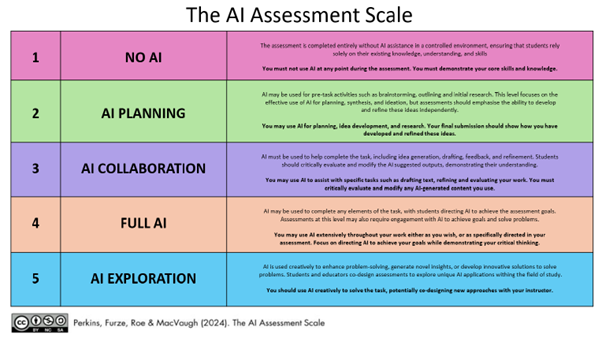
Source: https://aiassessmentscale.com/
So, what may this AI assessment scale look like in practice?
Level 1: No AI
At this level, students must rely solely on their own skills and knowledge in a controlled environment.
- Performing Arts: Students choreograph or generate music in preparation, but the final performance must demonstrate their own physicality and expressive skill without AI assistance.
- Visual Arts: Under exam conditions, students compare physical artwork without digital access to ensure they are demonstrating their own visual analysis skills.
Level 2: AI Planning
AI may be used for 'pre-task' activities such as brainstorming or initial research.
- Religious Education: Students might use AI to outline a narrative or transcribe a complex passage to improve their comprehension before completing the final task independently.
- Science: Students can input their own notes into a Large Language Model (LLM) to generate flashcards or dot-point summaries to assist with their revision.
Level 3: AI Collaboration
Students use AI to help complete the task, but they must critically evaluate and modify any AI-generated content.
- Performing Arts (Preparation): Students may use AI to generate backing music or take suggestions for choreography that they then evaluate and incorporate into a final performance.
- Science (VCE): Students can ask AI to summarize complex academic journal articles into 'plain English,' which they then synthesize into their own scientific report.
- Design, Art and Technology (DAT): AI can be used to compile research on various art styles, which students then cross-reference against other evidence to challenge the AI's accuracy.
Level 4: Full AI
AI is used extensively, allowing the assessment to focus on higher-order skills like delivery, critique, or directing the AI.
- English: To isolate public speaking skills, students use AI to generate a speech script. The assessment then focuses entirely on their delivery, such as tone, voice, and non-verbal communication.
- Health and Physical Education (HPE): Students use AI to generate a full response to a health inquiry and are then tasked with grading that output, identifying gaps, and fact-checking its claims.
Level 5: AI Exploration
Students and teachers co-design assessments to explore unique AI applications creatively.
- Humanities: Students use iterative prompting to create a historically accurate Roman scene via an AI image generator, refining the prompts based on their historical knowledge.
- Drama: Students generate a script segment using AI, perform it, and then feed their critique of the flow back into the AI to generate an improved version.
The College’s AI Policy may be accessed via PAM, and it is in the Learning and Teaching folder of the Parent Handbook.