OLMCBI 209

OLMC
Heidelberg
News

Edition 10 | 24 July 2026
Judith Weir
Principal

Welcome back to Term 3 and another busy time at OLMC.

As you are aware, I was on Enrichment and Long Service Leave in Term 2. I am grateful to have had the time to travel, immerse myself in our Mercy charism and also do a little further study.

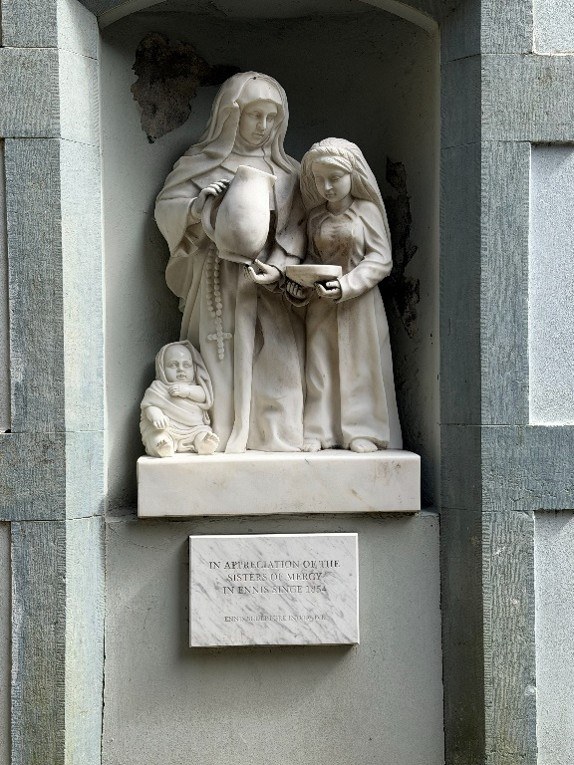
During my time away, I had the very great privilege of travelling through Ireland following the path of the Sisters of Mercy. As I travelled, I was struck by the many plaques, statues and other public displays of gratitude for all that the Sisters of Mercy did in support of those who were in need throughout Ireland. I have included an image from Ennis, a small town but one that has expressed gratitude so beautifully. My photography skills are not amazing and so it may be hard to read the message, but it says; 'In appreciation for the Sisters of Mercy in Ennis since 1854.'

I have also included a photo of the iconic image of Catherine McAuley, which is outside Mercy House in Baggot Street, Dublin. Mercy House was the first ministry built by Catherine and holds enormous significance for all who work in Mercy Ministries the world over. My experience gave me a great insight into the past and the present work of the Sisters of Mercy and the many people who carry on that work throughout the world. It is really a privilege and a blessing to be part of something so great, doing so much for so many across the world.

I also had an opportunity to spend time in the Vatican City, attending Mass at St Peter’s Basilica and also the praying of the Angelus led by Pope Leo XIV. As part of his address to the audience, gathered to share in prayer, Pope Leo spoke of the Church as ‘a place to encounter love, and live where heaven and earth already touch.’ Pope Leo XIV reminded us that the life of the Triune God ‘gives peace to our heart, which is often very restless.’ (The Vatican Newsletter, 31 May 2026)

There is much to take from this message of the Pope. It highlights our role as people of peace and hope, such an important role for all who work or live with young people.

As I reflect each year, Term 3 is an important one for making decisions. Almost everyone is contemplating where they want to be and what they hope to achieve in 2026 while casting an eye to what might be possible for them in 2027. It was heartening to see so many parents and students attending all of the events over the last two weeks. The information evenings and the Subject Expo held on Monday afternoon have been very well attended, with many parents as well as students, taking up the opportunity to learn about what is involved in the VCE subjects on offer.

In the evening, a large contingent of OLMC alumni returned to share their experience in a broad range of industries. This event was also highly subscribed and very much appreciated by all who attended. It was a privilege to host one of the rooms and listen to very experienced, successful and committed people talk about their work. Thank you to all alumni involved and if you would like to be involved in 2027, please contact our careers office here at school. It is wonderful to see OLMC students, no matter when they were students here, continuing their involvement in our community. It was also our privilege to celebrate the success of so many women who attended OLMC over so many years. It is one of our great blessings.

Term 3 is also one with many important community events. Some of the important events include Parent Teacher Student Interviews, the Celebration Concert and the Father’s Day breakfast. This year, Friday 14 August will be a student free day to allow our staff to participate in a faith and spirituality experience, immersing themselves in our faith and charism.

The Celebration Concert and Mercy Day will soon be upon us. Both occasions provide students with an opportunity to share in an enormous amount of fun as we watch so many of our students shine. They are also important moments which enable the development of community connections amongst students; therefore, we expect to see all students at school, particularly on Mercy Day, in order to be fully immersed in the joy of our Mercy Community.

AusAlert Test Monday 27 July at 2.00pm

On Monday 27 July at 2.00pm in Victoria, mobile phones, tablets and smartwatches will receive an alert as part of the testing of a new Critical AusAlert system. At the time of the test, a single Critical AusAlert test will be sent to every mobile device in Australia. Everyone with a compatible phone or other device in Australia can expect to receive the alert.

Devices will vibrate and play a siren-like warning sound for about 10 seconds.

An AusAlert message will appear on device screens. It will clearly say it is a test.

Exactly how it appears will depend on your device type and operating system.

Even if phones are on silent, the alert will still activate with a siren-like sound and vibration.

As this is a Critical Alert, it cannot be silenced through normal device settings. The only way to avoid receiving it is to have the device switched off or in aeroplane mode before the test.

The timing of the test coincides with a period of movement from the lunch break to Lesson 4; therefore, we will not be asking students to switch their phones to aeroplane mode. We are aware that for some of our students, loud noises can be concerning, and we will do our best to ensure that they are prepared.

Further information is available here:
https://www.ausalert.gov.au/alerts-explained/national-test

https://www.youtube.com/watch?v=-vohK4pETFA

We are looking forward to a wonderful Term Three and witnessing the achievements of our students as they wholeheartedly embrace all that is on offer at OLMC.
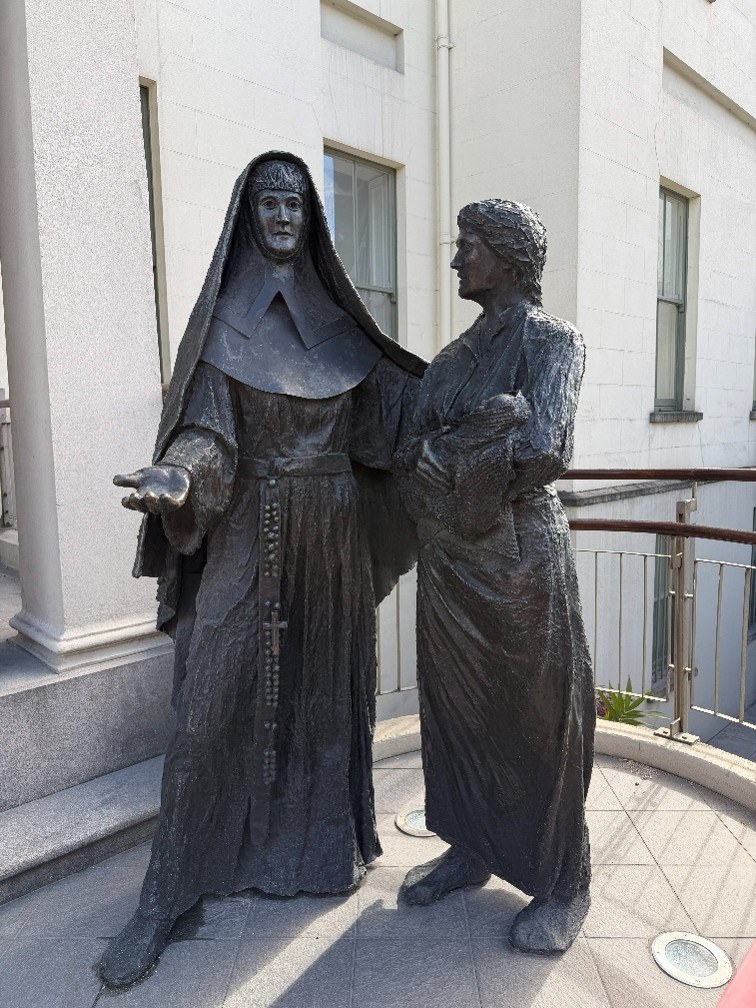
Catherine McAuley outside Mercy House, Baggot Street Dublin


Statue in Ennis, Ireland
Shane Taylor
Head of Faith and Mission

On 22 July, the Church celebrated the Feast of St Mary of Magdala, one of the most important women in the Gospels.

Mary came from the fishing town of Magdala, on the western shore of the Sea of Galilee, close to Capernaum where Jesus carried out much of his public ministry. She was one of Jesus' most faithful disciples, supporting his ministry, remaining with him at the foot of the cross, and becoming the first witness to the Resurrection.

For many centuries, Mary Magdalene was mistakenly identified with the unnamed sinful woman in another Gospel account. Today, the Church recognises her true place in salvation history: a courageous disciple whom the risen Jesus entrusted with announcing the Resurrection to the apostles. For this reason, she is often known as the ‘Apostle to the Apostles.’ In 2016, Pope Francis elevated her liturgical memorial to a Feast, recognising the significance of her witness and discipleship.

Mary's story reminds us that God calls each of us by name and invites us to be people of hope, courage and faithful witness. Like Mary, we are called to recognise the presence of the risen Christ in our lives and to share the Good News through our words, our actions and our care for others. For the young women of our Mercy community, Mary of Magdala offers a powerful model of discipleship: a woman of courage, fidelity and hope who remained close to Jesus, stood firm in times of uncertainty, and responded generously when called to proclaim the Gospel. Her example reminds us that faithful leadership begins with encountering Christ and then having the courage to share that encounter with the world.

Prayer

Loving God,

As we celebrate the Feast of St Mary of Magdala, we thank you for her faithful witness to the risen Christ.

When Jesus called Mary by name, her sorrow became hope, and she joyfully shared the Good News with others.

Help us to recognise your presence in our own lives, to listen for your voice, and to have the courage to share your love through our words and actions.

May we, like Mary, be faithful disciples who bring hope, mercy and compassion to everyone we meet.

St Mary of Magdala, pray for us.

Amen.

Above image: Three Marys at the Tomb of Christ from the Church of the Assumption of the Blessed Virgin Mary in Niegowić, Poland.

https://commons.wikimedia.org/wiki/File:Three_Marys_at_the_Tomb_of_Christ_from_the_Church_in_Niegowic_-_MNK_I-406_%28293783%29.jpg
Sr Emma Llewellyn RSM
Leader Staff and Student Formation

Welcome to Term 3 and an extra special welcome to any new members of our OLMC community. This term will have a particular focus on our Catholic identity and Mercy story, featuring our Staff Spirituality Day, OLMC High Tea (supporting McAuley for Women and Children) and whole school celebration of Mercy Day (in honour of the Feast of Our Lady of Mercy and founding of Catherine’s first House of Mercy - next year we will celebrate the 200th anniversary).

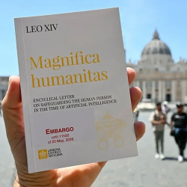
According to recent news (cf. CathNews and The Guardian), Pope Leo XIV has become the first faith leader to have his writings declared ‘AI free’ by receiving a ‘Proudly Human’ stamp, 'similar to the Australian Made or Fair Trade logo, labelling creative works including books, music, illustrations, films and even handcrafted items like jewellery as AI-free.’ That is not to say that our current pontiff is against the use of AI. In fact, his first encyclical letter – Magnifica Humanitas (Magnificent Humanity): On safeguarding the human person in the time of Artificial Intelligence – has a special focus on AI. In this Pope Leo XIV does not merely talk about technology and its associated risks, but rather focuses on the relationship between faith, human dignity and technological innovation. He emphasises the need to preserve humanity within the changes and challenges of our time, and to use AI ethically and responsibly.

One section of this encyclical that speaks to those of us engaged in education, technology and young people is this:

Let us invest in education, beginning with ourselves! We all need to learn how to engage with the digital world in a human way, as an integral part of our education in the faith and in a life lived according to the Gospel. Indeed, we must consider the digital world as a new continent to be evangelised, one that requires generous missionaries who are mature in the faith. In a particular way, we need adults to rediscover their vocation as artisans of education, prepared to work patiently each day, with the support of extensive and shared educational partnerships. Today, accompanying children and young people in using technology for developing responsible relationships, helping them to recognise the risks and choose what fosters inner freedom, is a concrete form of charity and will safeguard their dignity. Teaching new generations that technological evolution does not follow a predetermined path, but can be guided by personal and collective responsibility, constitutes one of the most valuable services to the common good. (para. 238)

Digital technologies and artificial intelligence are changing the way we work, communicate, learn, build relationships, and even understand ourselves. As Christians, we are called to be builders of communion, artisans of peace and weavers of hope, even in the digital age, and to live this time with discernment, hope and responsibility. Pope Leo XIV’s encyclical encourages the rediscovery of our ‘magnificent humanity’ and the fostering of a civilisation of love, so that every innovation may be illuminated by the Gospel and oriented toward the common good.

If you would like to read this encyclical in full, you can access the English version here. You might also appreciate reading this summary or accessing this pastoral kit.

Joanna De Bono
Deputy Principal - Learning and Innovation

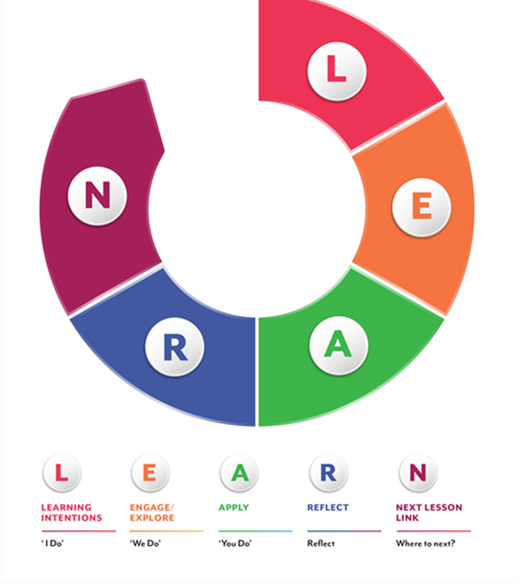
The LEARN Instructional Model

The LEARN Instructional Model is a strong feature of the OLMC Learning and Teaching focus. The fundamental basis of this strategic framework is that classroom environments that enable students to focus on and engage with lesson content provide an important foundation for learning success. Routines support students in being ready to engage and can facilitate their learning.

With clear routines, students understand and are more able to demonstrate what is expected of them. Routines also ensure students know what they can expect from their teacher during the learning process, and how actively participating will help them achieve their goals. The experience of predictability and safety in a learning environment that includes routines contributes to positive relationships and learning success.

Key points from the research

• Overloading working memory with inconsistent expectations and environmental distractions can interfere with learning by hindering the transfer of information to long-term memory.

• Rules and routines structure the learning environment, helping to manage cognitive load with a consistent and predictable approach to support students’ focus, engagement and efficient information processing.

Their efficient, productive and automatic execution reduces wasted learning time and helps free up students’ working memory to focus on learning.

• To create safe learning environments, rules and routines should reflect culturally responsive and inclusive practices.

• Routines that target different aspects of the learning process support students in being ready for and successful in their learning, enhance self-efficacy and increase motivation and effort. They can also be used to express shared values, norms and aspirations, such as routines for celebrating success, recognising positive effort in learning and providing constructive feedback.

Understanding this practice

These examples demonstrate what establishing and maintaining rules and routines might look like in the classroom, and potential misapplications in practice.

What it is:

  • Rules and routines are aligned with school-wide processes for consistency and predictability, and used across the school so students know what is expected of them and what they can expect from their teachers.
  • A consistent and predictable approach to the way tasks and activities are completed and lessons are structured, so students can focus on the content of their learning.
  • A small number of rules and routines designed for simplicity, explicitly taught and practised so students can develop automaticity and focus on their learning.
  • Rules and routines that are responsive to students' needs and how students learn, to support them in achieving learning success.
AERO, Practice guide for primary and secondary schools. February 2024
Andrew Gibson
Director of Learning and Teaching

I recall a few years ago our teacher librarian running a research session for students studying Politics regarding a dangerous chemical that was common in our homes, our schools and our community. That this chemical was the primary cause of excessive sweating, if inhaled it could lead to death, and prolonged exposure to its solid form could cause tissue damage. A professional looking scientific website that listed the dangers of this chemical, Dihydrogen Monoxide, provided a range of scenarios where this chemical would impair and damage us, and called for us to contact our local members of parliament so that action could be taken. It implied that the government was actively trying to prevent us from knowing of this chemical’s harm.

Dihydrogen Monoxide is more commonly known as water. The website was a parody designed to expose how susceptible we can be to misinformation, as well as exploiting a lack of scientific literacy. Our librarian’s intention in running this activity was to make us aware of the need of being critical researchers, and critical consumers of knowledge, and that research frameworks for assessing information help us find accurate and reliable information.

The ability to research effectively is an important skill across many Learning Areas, and an invaluable skill for life. Over the years students have been taught using the C.R.A.A.P framework to evaluate a source for its intended authority, accuracy and purpose. However, with the increasing use of Artificial Intelligence to summarise sources in search engines, we recognise that the previous framework while still relevant in intent, was not as successful in guiding our actions with how information is currently presented. Further, the adaptive nature of AI in search engines may actively support confirmation bias in our research, and can be a conduit for misinformation and in some cases disinformation.

In our Artificial Intelligence Policy, we refer to the SIFT method as being the preferred framework we will be using when undertaking research, and more broadly when considering sharing information. Not only is SIFT a great acronym in communicating the active search for accurate and reliable information, each of the letters represents a logical step in the research process.

SIFT stands for:

  • Stop: pause before sharing or acting on information.
  • Investigate: check the source's credibility.
  • Find: seek better coverage or context.
  • Trace: track claims to their original sources.

Stop: pause before sharing or acting on information. In a world that is competing for our attention, some sources may seek to provoke an emotional response. Rather than trusting it because of how it may support what you know, stop to consider how it makes you feel, as sometimes an emotional response can compromise our ability to think critically about information.

Investigate: check the source's credibility. What sites have been used in the generation of the AI summary? How trustworthy are these sites? Is the purpose of these sites to inform, such as news or educational sites? What can the ‘URL’ of the site tell us about the reliability of the content from the site? Does the source have expertise on this topic?

Find: seek better coverage or context. Step outside the search engine, or the AI tool. Don’t accept the first search result but look for other trusted sources to corroborate information by opening new tabs on the topic. This is sometimes referred to as lateral reading, where you open adjacent tabs to find other sources on the topic, and perhaps find information on the origin of the first source. This assists in validating claims, identifying motives and can help avoid deception. There have been items in the news recently of a lawyer submitting documents that referred to non-existent cases, due to what is sometimes called an AI Hallucination.

Trace: track claims to their original sources. If a site provides a claim or a quote, trace it back to the original context. Sometimes quotes can be taken out of context, and the headlines of an article may be sensationalised to present a particular perspective.

The SIFT framework is an important approach to help ensure that we are critical consumers of information and it is an efficient method to identify the reliability of information. Unlike the previous framework, SIFT acknowledges the emotional responses that online content often seeks to generate. By ‘stopping’ it allows us to ‘breathe’ and follow a process to discern the accuracy and reliability of the information being provided.

Andrew Gibson
Director of Learning and Teaching

Through our work with Elevate Education, we have access to their Parent Webinar Series. Elevate Education's Term 3 Parent Webinar program is listed below.

These webinars are held on a Wednesday.

How to Get (And Keep!) Your Child Motivated
August 5, 6.30-7.30 pm

How To Help Your Child Improve Their Note Taking
August 19, 6.30-7.30 pm

How You Can Make Technology an Ally (& Not the Enemy!)
September 2, 6.30-7.30 pm

How You Can Support Your Child During Exams
September 16, 6.30-7.30 pm

If you would like to attend one or more of the webinars, please register via the link below.

Elevate Education School Webinars

Our Year 9 to 12 students are currently exploring the below topics in our Religious Education classes:

Year 9: Female Prophets of the Hebrew Scriptures

Our Year 9 students are diving into the Hebrew Scriptures with a focus on powerful female figures, particularly Ruth and Deborah. Through these studies, students are examining the vital leadership, courage, and faith these women demonstrated in their communities. It’s been inspiring to see students connect these ancient biblical narratives to timeless lessons on loyalty, justice, and resilience.

Year 12: Ethical Issues Group Presentations

In Year 12, students are kicking off a major focus for the term: their Ethical Issues Group Presentations. Working collaboratively, each group has selected a contemporary ethical dilemma in society, ranging from fast fashion and environmental sustainability to social justice issues. They are actively researching diverse perspectives, applying ethical frameworks, and designing engaging presentations to teach their peers.

We encourage you to chat with your Year 12 student about the issue their group selected; discussing these big questions at home is a great way to help them sharpen their arguments and perspectives!

Thank you for your continued support in your child’s learning journey.

Grace Austin
Religious Education Learning Leader

This competition is designed to challenge and extend students' problem solving skills. It will take place at OLMC on Wednesday 5 August, lesson 2 and 3. The competition runs for 75 minutes and is made up of a Junior division for Year 7 & 8, Intermediate division for Year 9 & 10 and a Senior division.

We have 57 students entered in the Junior division and 11 students entered in the Intermediate division.

We wish these students luck on the day of the competition.

Filippo Di Natale
Mathematics Learning Leader

It has been a busy and productive first semester for the Student Leadership Team. Looking back over the past few months, a clear highlight for both the Student Representative Council (SRC) and the Student Leadership Team (SLT) was their outstanding achievement with Dare2Donate at the end of last term. I am so very proud of their work and the success of their efforts. Working alongside the Social Justice Team, our student leaders brought our whole College together in a clear demonstration of community spirit, showcasing the best of OLMC. Being a Mercy College is about compassion in action, and it is important that we take these moments to pause, take stock, and reflect on the impact we can have when we unite for a greater cause. The Student Leadership Team demonstrated not only a strong spirit of collaboration, but also unwavering tenacity, persistence, and determination, to allow the College to shine.

As we concluded last term, we also had the pleasure of expanding our ranks. The Year 7 cohort formally elected their representatives to the SRC, and we warmly welcome Isis and Bonnie to the fold. We are thrilled to have them on the team and are looking forward to harnessing their wonderful enthusiasm over the coming months.

This term will undoubtedly prove to be another bustling one. It is a particularly poignant time for our Year 12s, as this will be the last term they are fully undertaking their leadership roles, before they transition into exam and graduation preparation in Term 4 and take their next bold steps into the wider world. However, they still have a substantial task ahead of them in continuing to lead and preparing for Mercy Day at the end of the term. Dedicating themselves to this final term and final event is a beautiful way for them to cement their legacy at the school. As we all know, Mercy Day is one of the true cornerstones of the College calendar—a unique and special day where we can come together as a community to celebrate the very best of all that we are and all that we have come from.

Following the Mercy Day Fair, the afternoon will transition into the much-anticipated House Arts extravaganza. Our Arts Leaders will take the helm in organising the afternoon's programme, whilst the House Captains and House Vice Captains are already working diligently to ensure their Junior and Senior acts are ready for the stage. There is a unique beauty in being part of a place where we can celebrate all the wonderful and varied talents of our school community, whilst also providing a time where we can simply bask in the joy of silliness, fun, and the quiet warmth of shared connection.

Alongside these celebrations, we are also looking to the future. This week marks the commencement of the 2027 Student Leader Application process, an endeavour in which our current Year 12 leaders will play an active and guiding role. Over the course of this term, courageous Year 11 students will put themselves forward for the demanding process of being elected as our next student leaders. It is a rigorous journey that includes comprehensive written applications, delivering speeches in front of their cohorts, and undertaking an extensive interview process. All application information, timelines, and forms can be found on the Student Leadership Website. We strongly encourage all Year 11s who have a genuine desire to help shape and lead our community to put themselves forward. Striving for leadership requires bravery, but it is an incredibly rewarding journey. Please note that applications will close on Thursday 30 July at 10.00 am.

We wish all our applicants the very best and look forward to seeing the talent that emerges.

As always, it will be a demanding term for all our student leaders, but they have proven time and again that, together, they are able to achieve wonderful things and lead our College from strength to strength.

Jess Battersby
Student Leadership Coordinator

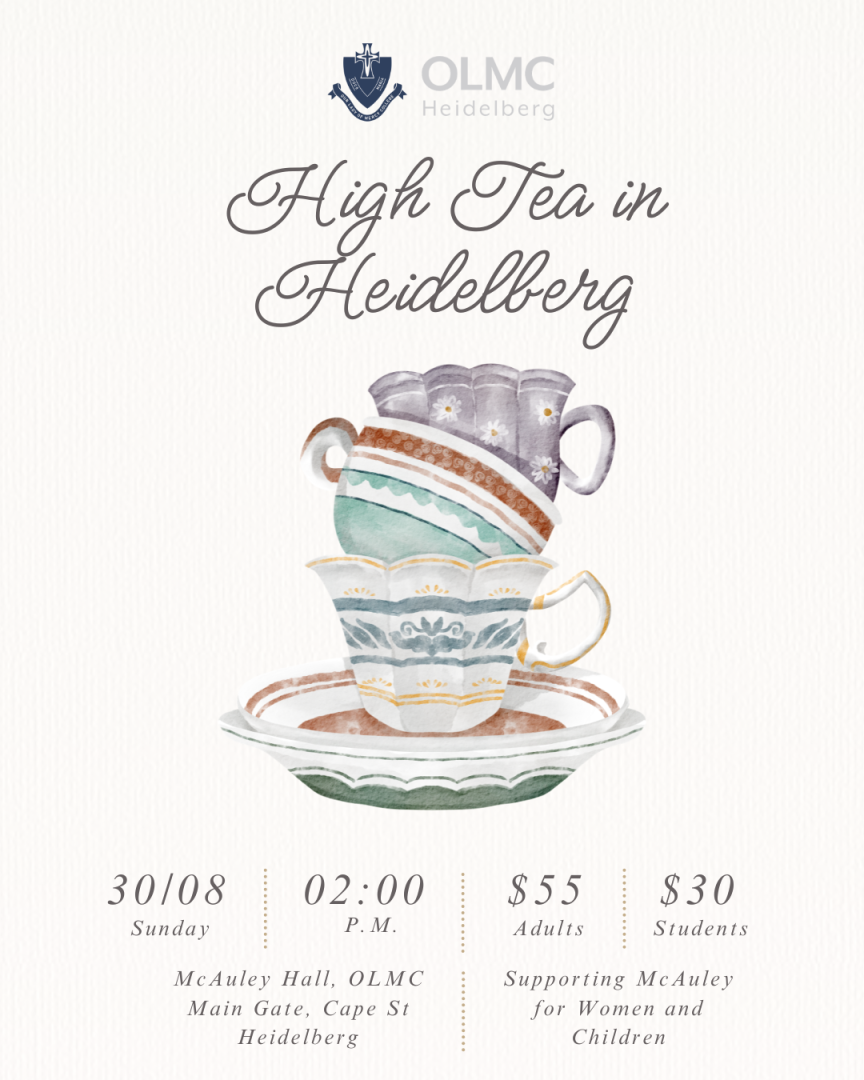
Our annual High Tea in Heidelberg is on Sunday 30 August at 2.00pm and we invite you and your friends and family to share in this special event.

The event will support the work of McAuley for Women and Children (McAuley), an organisation committed to advocating for a better, safer and just society through working with women and children affected by family violence, mental illness or homelessness.

Sunday 30 August 2.00pm – 4.00pm

McAuley Hall, OLMC, Cape Street, Heidelberg

Booking Arrangements

Tickets are priced at $55 for Adults and $30 for Students.

You can purchase tickets online by going to Trybooking and searching OLMC

OR by entering the link https://www.trybooking.com/DOCRE

OR by contacting Monica Agius T: 9455 7571 E: magius@olmc.vic.edu.au

To book a group/table, you can either purchase the whole table in one booking or purchase a ticket on an available table and then notify your guests of the table number they should specify when booking. If you want to rename the table so that your fellow guests can identify the table easily please contact Monica Agius. Tables will seat 10 people.

To book individual tickets, purchase the required number on any table.

Apply Online

Apply now for Year 7 2028

Applications for Year 7 2028 at OLMC Heidelberg close Friday 14 August 2026. Apply online now.

Apply now

OLMC College Tours

Prospective families are invited on a tour of the OLMC facilities followed by an information session with Principal Judith Weir, Transition Coordinator Rowena Thomson and two students.

BOOK NOW

Follow the official Our Lady of Mercy College accounts on Facebook, Instagram and LinkedIn. We’ll be sharing regular news, student achievements and stories from around the College.