


The image above shows Catherine’s first House of Mercy on Baggot Street, Dublin, which is now home to Mercy International Association (MIA).
As Mercy Day is fast approaching – Thursday 17 September (second last day of Term 3) for our OLMC community – I would like to highlight the history and meaning behind this special day. Mercy Day commemorates the opening of the first House of Mercy on Baggot Street in Dublin on 24 September 1827. As this usually falls during our school holidays, many Mercy schools across Australasia choose to celebrate Mercy Day at the end of Term 3.
According to American Sister of Mercy, scholar and biographer of Catherine McAuley, Mary C. Sullivan RSM (1931-2025):
‘September 24 in 1827 was the Feast of Our Lady of Mercy, an ancient feast day of Jesus’ Mother Mary (now no longer a feast day in the calendar of the Roman Church). On that day, God asked us to do what Mary had always done: to stretch out over all God’s beloved people the Shawl of God’s own merciful comfort and help, the sheltering Cloak of God’s own tenderness.
September 24 was for centuries the ancient feast of Our Lady of Mercy, also called Our Lady of Refuge and Our Lady of Ransom. To hono[u]r this feast, many Renaissance artists such as Piero della Francesca, chose to paint Mary in a long red dress with her wide and outstretched blue cloak mercifully sheltering men, women, and children.
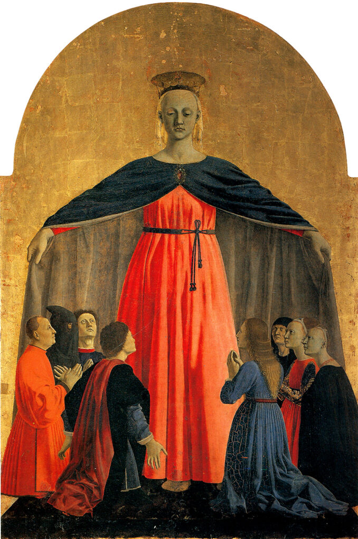
Image from: Piero della Francesca—in his Madonna della Misericordia
And in Dublin on that day in 1827, Catherine McAuley extended the great Shawl of God’s Mercifulness by opening wide the front door of the newly built House of Mercy on Baggot Street, and beginning a protective school for poor Irish girls, and a welcoming shelter for homeless servant women.
Catherine’s sister Mary had died in late August, and Catherine was now caring for Mary’s five children, two young cousins, and at least two orphans. Therefore, she herself could not live at Baggot Street just then, so she asked her fifteen-year-old cousin Catherine Byrn and a new friend, Anna Maria Doyle, to move into the house on September 24, 1827, and to open wide the Merciful Shawl of the school and the shelter on that very day.
Ever since then, the gift of God’s own out-stretched Merciful Shawl has been a persistent, enabling call to each of us throughout the Mercy world. It daily asks us weak, ordinary human beings to accept the weight and duties of God’s Shawl of Mercy and to extend its sheltering comfort to all God’s beloved people.’
(Extract taken from: https://www.sistersofmercy.org/mercy-day-what-shall-we-wear/)
Catherine McAuley was able to establish the first House of Mercy using the wealth that she inherited from William Callaghan (his entire estate and effects, equivalent to ~$5 million today). William (a Protestant) and his wife, Catherine (a Quaker), were an elderly, childless couple who Catherine worked for as household manager and lived with as companion for almost 20 years. Using this unexpected inheritance, Catherine was able to purchase land and build a large house that was fit-for-purpose (a school for poor girls, and a shelter for homeless servant girls and women), choosing to do so in the wealthy part of Dublin. It is worth noting that Catherine did this as a single, lay, Catholic woman, during a time when Catholics were experiencing immense discrimination, injustice and poverty in Ireland, and before Catherine became a religious sister and founded the Sisters of Mercy.
We look forward to celebrating this coming Mercy Day here at OLMC, especially in this special 180th anniversary year of the arrival of Mother Ursula Frayne and the first Sisters of Mercy in Australia (on 8 January 1846 in Fremantle, Western Australia).